
The Living Web: Yoga, Fascia, and the Science of Transformation
by Charles MacInerney, E-RYT 500, C-IAYT
Yoga’s benefits have never been a secret to those who practice. Increased strength and flexibility, better balance, improved digestion, reduced anxiety, greater emotional resilience — these have been experienced and reported by practitioners for thousands of years, and confirmed in the past few decades by a growing body of clinical research. What is new, and genuinely astonishing, is the depth at which science is now showing us why yoga works — and the picture emerging is far more profound than anyone anticipated.
The key is a tissue most of us have barely heard of: fascia.
The web within
Fascia is the body’s connective tissue — a continuous, three-dimensional web that surrounds every muscle fiber, wraps every organ, lines every joint, and connects everything to everything else. For most of medical history it was treated as packaging, the white filmy material you cut through to get to the “real” structures. That view has been thoroughly overturned. Fascia is now understood as a living, sensing, communicating organ in its own right — the largest sensory organ in the body, in fact, containing more nerve endings than any other tissue.
It is also the body’s hydraulic system. Embedded within fascial layers is the lymphatic network, whose capillaries depend entirely on fascial movement — stretching, compression, breath — to circulate immune cells and clear metabolic waste. A 2018 study identified the interstitium, a body-wide network of fluid-filled channels within the collagen bundles of fascia itself, now proposed as a distinct organ. When fascia moves freely, this fluid circulates. When fascia is restricted or dehydrated, it stagnates — and the tissues it serves suffer.
Anatomist Thomas Myers mapped the fascial web into lines he called Anatomy Trains: continuous tensional pathways running the full length of the body. The Superficial Back Line runs from sole to scalp; the Deep Front Line threads from the inner arches through the psoas, diaphragm, and throat; the Spiral Line wraps the body in a double helix governing all rotation. A yoga pose, understood through this lens, is not a stretch of an isolated muscle — it is a tuning of the entire web, with effects that ripple through every system the web touches.
From the mat to the molecule
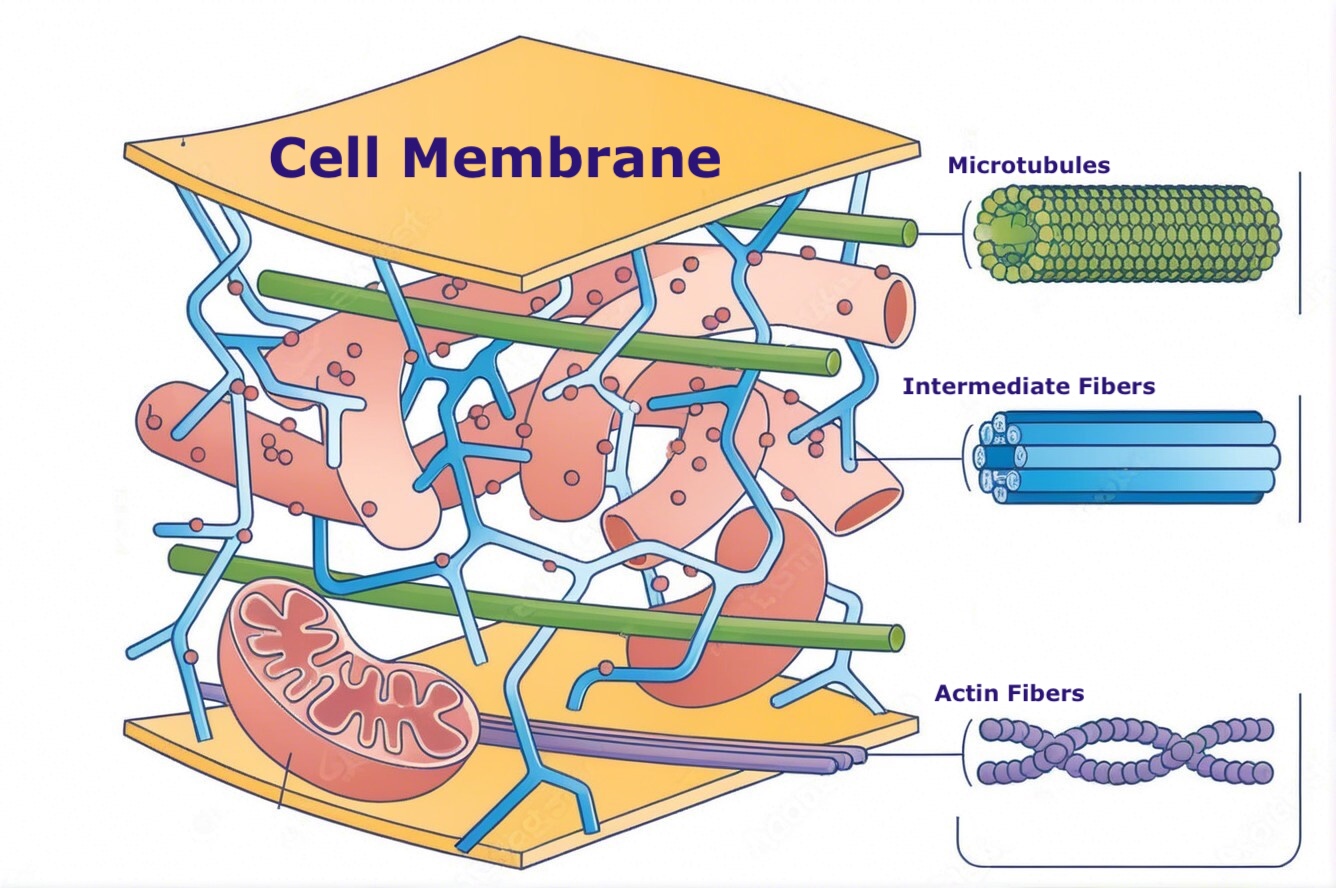
Here is where recent science becomes remarkable. The fascial web does not stop at the cell membrane. Inside every cell is a cytoskeleton — a network of protein fibers that mirrors, at microscopic scale, the three fiber types of fascia itself: tension-bearing actin filaments, resilient intermediate filaments, and architecture-organizing microtubules. And these two systems are physically connected.
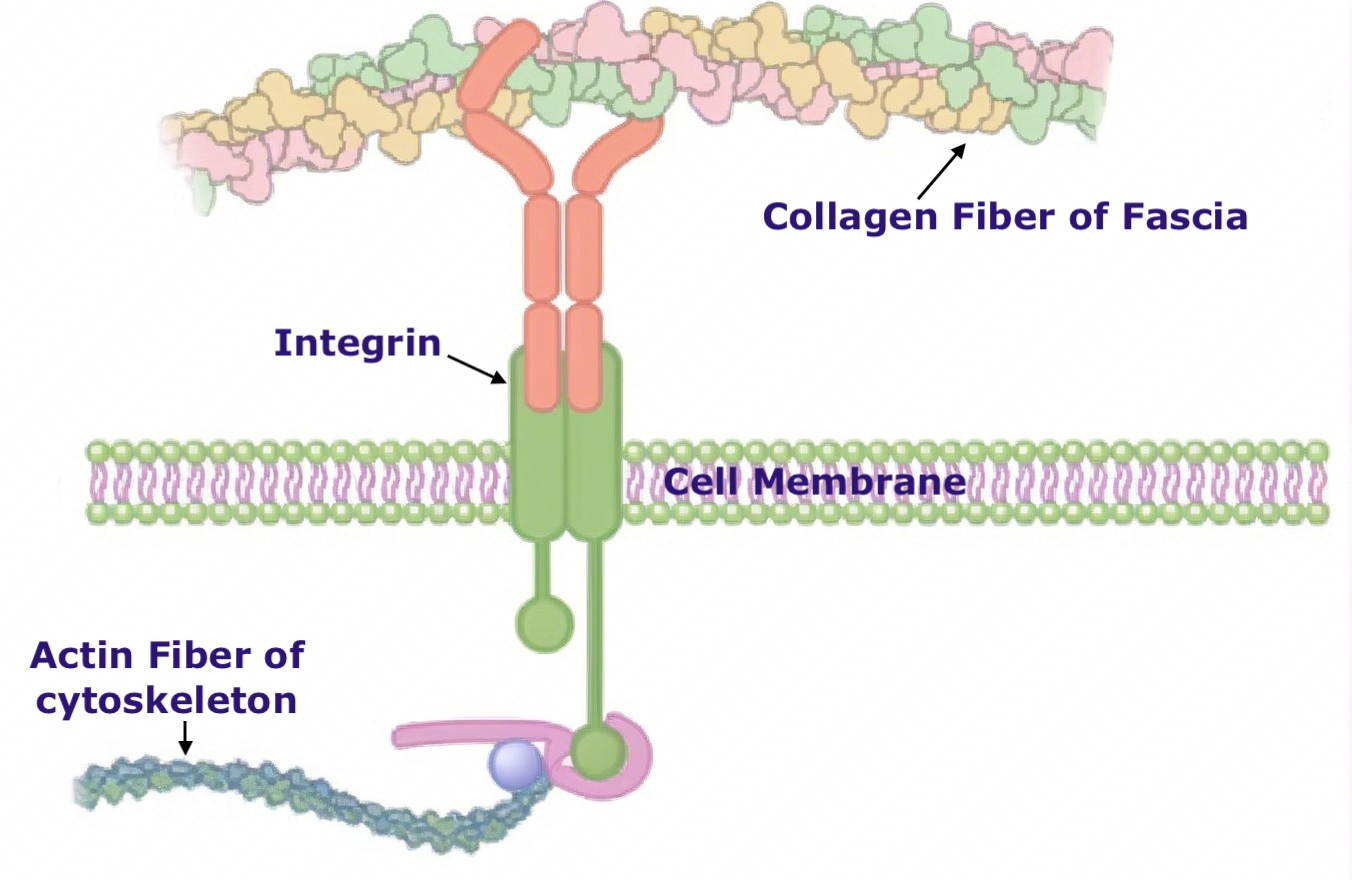 Spanning the cell membrane are proteins called integrins — molecular bridges that reach outward into the fascial matrix and inward to the cytoskeleton. Through integrins, the tension in a collagen fiber in your fascia is directly, mechanically continuous with the tension in a protein filament inside your cell. The body is one tensegrity system, operating simultaneously at the scale of the whole body and the scale of the molecule.
When mechanical force travels through this pathway — from fascial fiber through integrin into the cytoskeleton — it triggers a process called mechanotransduction: the conversion of a mechanical signal into a biochemical one. The force deforms the cell’s nucleus, changing which regions of DNA are physically accessible to the cell’s gene-reading machinery. A yoga pose, in this light, is not just a stretch. It is a signal, delivered from the body’s surface to the genome, that says: adapt.
This is not speculation. Research from Harvard’s Benson-Henry Institute has shown that yoga and relaxation practices produce measurable changes in the expression of genes associated with inflammation, immune function, mitochondrial energy production, and telomere maintenance — in some cases after a single session, and progressively with sustained practice. Studies by Dr. Loren Fishman have demonstrated that 12 minutes of daily yoga practice significantly improves bone mineral density over time — a direct result of mechanical loading signals traveling through fascial and bone tissue to the cells that build and maintain bone.
The implications for practice
What this means is that yoga’s benefits are not vague or merely subjective. They operate through precise biological mechanisms, and they reach to the deepest level of our biology. Every mindful movement loads the fascial web and moves its fluid. Every conscious breath cycles the diaphragm through its role as lymphatic pump, vagal stimulator, and fascial tensioner. Every long-held pose sends sustained mechanical signals through the integrin pathway to the nucleus, influencing which genes are expressed and which are not.
The ancient traditions were describing something real. The body is not a vehicle for consciousness to tolerate while the mind does the real work. The body is the path. The web is alive. And every pose we take is a conversation — conducted at the most intimate biological level — between how we inhabit our form and who we are becoming.
Charles MacInerney (E-RYT 500, C-IAYT) has practiced yoga for over 50 years and taught for 35. He offers classes and retreats at yogateacher.com and hosts the annual Texas Yoga Retreat at texasyoga.com.